


Reluctant Reader? Why Your Kid Won't Read the Books You Pick

There's a stack of books on the nightstand. You did the research. You picked the ones with the best reviews, the ones every list said reluctant readers love. And your kid hasn't touched them in two weeks.
You're starting to wonder if it's you. If you picked wrong again. If your child is just one of those kids who doesn't like reading.
It's not the book list. It's the match.
The short answer is: most "best books for reluctant readers" lists rank books by popularity or awards, not by fit. A book works for a reluctant reader when three things line up at once: reading level, interest, and format. And when the book they love is above their level, they don't have to read it alone. The goal here isn't a number of books or minutes. It's a child who loves reading and learning, and who's building real thinking skills along the way. |

New to some of these terms? There's a parent-friendly glossary at the bottom of this post. Jump to Glossary |
You're not imagining the bigger picture. In the 2025 Nation's Report Card long-term trend results, only 14% of 13-year-olds said they read for fun almost every day, down from 35% in 1984 (NPR via Michigan Public, June 2026). So if your house feels like a reading standoff, you have a lot of company.
And kids are telling us what helps. In Scholastic's Kids & Family Reading Report, 89% of kids agreed their favorite books are the ones they picked out themselves, and 4 in 10 said they have trouble finding books they like (Scholastic, 2019).
Why won't my kid read any of the books I pick?
Because most book lists rank by popularity or award, not by fit. You search "best books for reluctant readers." You find the highly rated one. You hand it over, and your kid reads a page and puts it down, maybe forever.
Fit means three things have to line up at the same time: reading level, interest, and format. A text-heavy novel and a graphic novel aren't interchangeable just because they're both about dinosaurs. When one of those three is off, the book becomes one more thing your kid failed at, even when the topic was right.
So before you pick another book, ask what they'd watch, not what they should read. A kid who will watch a three-hour nature documentary but won't touch a nonfiction book at their reading level isn't a non-reader. They're a mismatched reader.
What actually makes a book work for a reluctant reader?
Whether your child's brain can build a mental map of the text as they go. Picture the same reluctant reader with two books, same reading level, same rough topic. One gets abandoned by page three. The other gets finished in a weekend. The difference isn't the book's quality.
Think of it like a GPS for reading. Every reader builds a kind of map while they read: where the story is, what just happened, what's coming next. Books that overload that process, because they're too dense or too unfamiliar in structure, get abandoned even when the topic is something your child genuinely loves.
That's where my Text Guidepost method comes in. After each chunk of reading, your child jots two or three words on a sticky note. Those notes become guideposts along the route. When they get lost, they follow the guideposts back instead of rereading the whole thing, and the map stays clear in their head. I explain why this matters so much for working memory in Why Your Child Can Decode Fine But Still Can't Understand What They Read.
Does my reluctant reader have to read every book alone?
No. I wish more parents heard that, especially once kids hit 4th and 5th grade and everyone expects them to read on their own.
Think of it as a Reading Ladder. Each step on a ladder is called a rung. On the bottom rung, you carry most of the reading. On the top rung, your child reads on their own.
Here are the five rungs:
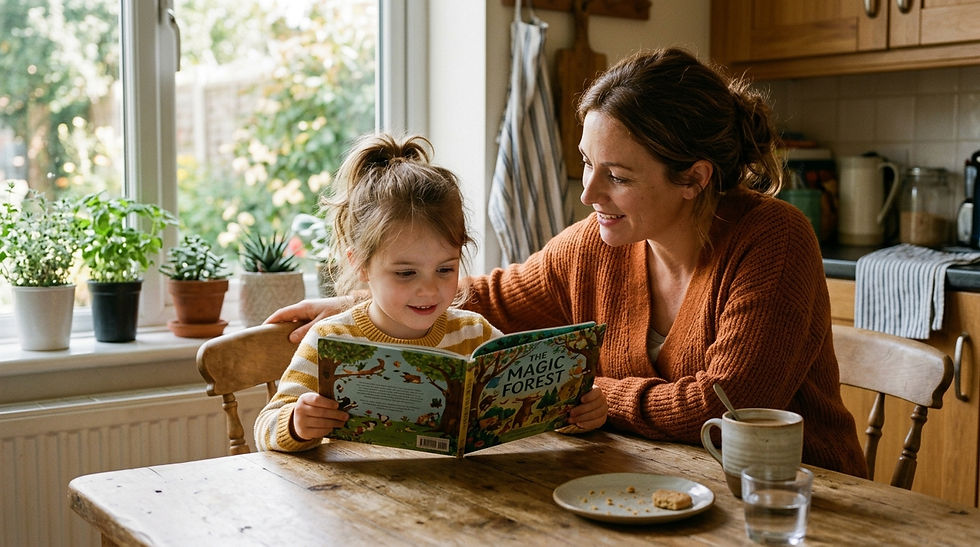
Rung 1: You read aloud while they listen and talk about it.
Rung 2: They listen to the audiobook while following the print.
Rung 3: You take turns, a page for you and a paragraph for them. (Doing the character voices helps a lot here. I share how in The Voice Acting Secret That Turns Reluctant Readers Into Story-Obsessed Kids.)
Rung 4: They read, with you nearby for a tricky word.
Rung 5: They read on their own.

Kids move up and down the ladder depending on the book, and every rung counts. The match decides the book. The ladder decides how you share it.
One important note: the ladder doesn't replace your child's independence or their decoding practice. They still need time on the top rungs with books at their own level, plus any practice from school or tutoring. The lower rungs give them something different: access to the book they're excited about, and the chance to understand it and think about it at their full level. It works a lot like glasses, which I explain in Is Text-to-Speech Cheating? (Why It's Actually Your Child's Glasses).
The research backs this up. Kids can understand far more by listening than they can read on their own, and that gap lasts from early childhood through at least middle school (Reading Rockets). Kids want it too. In one Scholastic survey, 40% of kids ages 6 to 11 who had been read aloud to at home wished their parents had kept going (Scholastic Kids & Family Reading Report, 2015).
I learned this early in my career. Years ago, I had a second grader who really wanted to read a Harry Potter book. It was way above his reading level, and the librarian at the time was worried about letting him check it out. But his interest was so high that I checked the book out for him myself and read it with him. Wherever their interest is, that's where their love of reading is going to start.
FREE: The Book Match GuideFind the book your child will actually finish. Inside: three questions to ask before you pick the next book, the Reading Ladder, a starting list by interest, a one-page level check, and a printable Family Learning Board for your fridge. |
Where do I start?
Pick by interest and format together, not by age or grade alone:
1. Name three things they'd watch. Shows, YouTube channels, games, sports.
2. Match the format to how they already take it in. A documentary fan may love photo-heavy nonfiction like the Who Would Win? series. A cartoon lover may settle right into a graphic novel like Dog Man.
3. Check the level with one page. If it's a stretch, move down the ladder and share it.
4. Let them choose from three or four options you bring home. Choice is part of the match.
The way in doesn't even have to be a book. In our house, it was Pokemon cards. My husband used them with my son, and they became one of the ways he got interested in reading. And if your child is into something unusual, try the movie first, then read the book and look for what's different. The movie gives them background knowledge, which matters more than most parents realize (Why Background Knowledge Matters More Than Reading Skill).
How do I keep it going without a reading log?
Try a Family Learning Board instead. On a whiteboard, the fridge, or a poster, add every book you finish together or on their own, with two quick notes: did we love it, and why? The "why" is where the thinking happens, and it tells you exactly what to pick next. If your family reading time keeps fizzling out, Why Does Our Family Reading Routine Never Last More Than Two Weeks? walks through how to make it stick.
The full starting list, sorted by interest with the best rung for each book, is in the free guide, along with a printable board.
Is it just reluctance, or could it be something more?
A lot of parents carry a quiet worry they don't say out loud: what if it's not just that my kid doesn't like reading?
Reluctance and a reading difficulty like dyslexia can look identical from the outside. Both show up as avoidance. Both show up as "I hate reading." Start with the basics, a recent vision and hearing check. Then a few things are worth a closer look, not as a checklist to self-diagnose from, just as permission to look closer:
☑ Does the avoidance happen even with books that clearly match your child's interest and format?
☑ Does your child do fine with a read-aloud or audiobook, but struggle with decoding the words on the page?
If both sound familiar, I go deeper in The Literacy Crisis Is Real, And It's Hitting Dyslexic Readers Hardest and in my video Why Is Dyslexia So Often Missed for Years?
The free Reading Clarity Checklist can help you put words to what you're seeing.
What if my child has ADHD, dyslexia, or both?
For kids with ADHD, interest is often the fuel. An ADHD brain tends to lock in on what's interesting and drift on what isn't. Short chapters, lots of breaks on the page, and a topic they already love give that attention something to hold onto. (More in ADHD and Reading: Why It's Not a Focus Problem.)
For kids with dyslexia, decoding takes real effort, so a book at their interest level may be well above their decoding level. That's where the lower rungs earn their place. Pair them with independent reading at their decoding level, and they get both. If your child has a qualifying reading disability, Bookshare is free for U.S. students, no IEP required.
Your One Thing This Week
Ask your child what they'd happily watch for an hour. Find one book on that topic, in the format closest to how they already enjoy it. Pick the rung that fits, and add it to your Family Learning Board when you're done. That's it.
Kelly 💜
Want the full starting list?The Book Match Guide is free. Pop in your email and it comes straight to your inbox. Already have it? Come tell me what your child would happily watch for an hour, and I'll reply with a book idea and a rung: Join the conversation in the community |
Read Next
Frequently Asked Questions
Q: Why won't my child read the books I choose?
A: Most book lists rank by popularity, not fit. A book has to match your child's reading level, interest, and preferred format all at once. Start by asking what your child would watch, then find a book on that topic in a similar format.
Q: Do audiobooks and read-alouds count as real reading?
A: Yes. Kids understand more by listening than they can read on their own through at least middle school, so listening lets them think at their full level. Pairing an audiobook with the print copy is a great middle step. See Is Text-to-Speech Cheating?
Q: Will audiobooks replace my child's reading practice or hurt their spelling?
A: They shouldn't replace it. Listening doesn't teach decoding or spelling by itself, so your child still needs practice at their own level. Audio adds access to the books they love, plus vocabulary, background knowledge, and comprehension. It works alongside practice, not instead of it.
Q: Should my 4th or 5th grader still be read to?
A: Yes, especially with books above their independent level. Many kids say they wish their parents had kept reading aloud. Mix shared reading with independent reading at their level.
Q: Do comics, graphic novels, and magazines count?
A: Yes. Your child is following a story, tracking characters, and connecting ideas. For a reluctant reader, they're often the format that finally fits.
Q: Should I pay or reward my child for reading?
A: I'd skip paying per book, since it can turn reading into a job. Celebrate on a Family Learning Board instead: what you read together, what you loved, and why.
Q: How can books compete with screens?
A: Use screens as a bridge, like the movie first or the game's guidebook, and set a short screen-free reading window, like the 15 minutes before bed. For the bigger picture on screens and reading, see The Digital Reading Crisis.
Q: My child reads the words but doesn't understand them. Is that reluctance?
A: Often it's not reluctance at all. It can be a comprehension layer that hasn't been taught yet. Start with Your Child Can Read But Doesn't Understand?
Q: How do I know if my child is reluctant or has a reading difficulty like dyslexia?
A: They can look the same from the outside. Rule out vision and hearing first. Then look closer if your child avoids books even when interest and format clearly fit, or understands read-alouds well but struggles to decode the words on the page. The free Reading Clarity Checklist is a good next step.
Parent GlossaryReluctant reader: A child who can read but avoids it. Reluctance is about willingness, not ability, though the two can overlap. Decoding: Sounding out written words. For children with dyslexia, this takes conscious effort and real mental energy. Reading level: How hard a text is for a particular reader. A book can be at your child's independent level or above it (better shared). Reading Ladder: Five ways to share a book, from you reading aloud (rung 1) to your child reading on their own (rung 5). Every rung counts. Listening comprehension: How much a child understands when a text is read to them. Text Guidepost: Kelly's map-making method. After each chunk of reading, your child jots a few words so they can find their way back. Family Learning Board: A family board that tracks the books you read, which ones you loved, and why. |
Sources
☑ NPR via Michigan Public, June 10, 2026 (2025 NAEP Long-Term Trend): https://www.michiganpublic.org/2026-06-10/after-years-of-declines-young-students-show-gains-in-reading-and-math
☑ Scholastic Kids & Family Reading Report, 7th ed., 2019: https://www.scholastic.com/newsroom/all-news/press-release/scholastic-biennial-survey-reveals-young-readers-face-challenges.html
☑ Scholastic Kids & Family Reading Report, 5th ed., 2015, via School Library Journal: https://www.schoollibraryjournal.com/story/books/scholastics-new-report-examines-kids-attitudes-on-reading
☑ Reading Rockets, Speaking and Listening in Content Area Learning (citing Sticht & James, 1984): https://www.readingrockets.org/topics/comprehension/articles/speaking-and-listening-content-area-learning
☑ Bookshare, Free Audiobooks for Your Struggling Reader: https://www.bookshare.org/campaigns/free-audiobooks-for-your-struggling-reader


Comments